
Why most systems fail early, and how to design for change instead of certainty.
Most architecture discussions assume stable requirements.
In real projects, that almost never exists.
Early on, requirements are incomplete, shifting, or just wrong, and you still have to define APIs, choose a database, and structure the system.
This is where most systems go wrong.
They're designed as if the future is already known.
You're Not Designing for Stability
In early-stage systems:
- product direction changes
- scale assumptions are wrong
- edge cases only show up in production
So the goal isn't to get the architecture right.
The goal is to design a system that can survive being wrong.
Where Systems Break
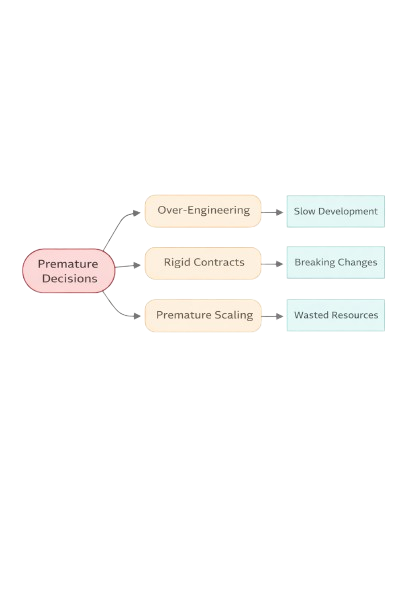
Over-engineering too early
Teams reach for microservices, queues, and complex infrastructure before the system actually needs it.
You end up with:
- slower development cycles
- fragmented logic across services
- coordination overhead between teams
I've worked on systems running on Kubernetes with barely any load, or services split before clear boundaries existed.
That's not scalability, it's friction.
Rigid contracts too soon
Early APIs and schemas are often treated as permanent.
They never are.
This leads to:
- breaking changes across the system
- painful migrations
- defensive code everywhere
Instead of enabling iteration, the architecture becomes the bottleneck.
Scaling before anything works
Many systems are designed for scale long before they have real usage.
This creates:
- unnecessary complexity
- wasted infrastructure
- slower iteration
At that stage, the real constraint isn't scale, it's learning speed.
Designing for Uncertainty
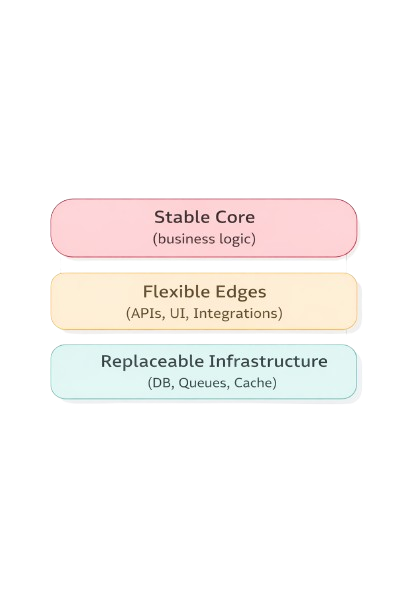
Start with a modular monolith
Not a mess, a structured system.
- clear internal boundaries
- shared database (initially)
- simple deployment
You get speed, clarity, and room to evolve without committing too early.
Delay irreversible decisions
Some decisions are hard to undo:
- database design
- service boundaries
- public APIs
If you're not confident they'll hold, keep them flexible.
If a decision doesn't need to be permanent, don't make it permanent.
Solve real problems, not hypothetical ones
Instead of asking, "What happens when we have 1 million users?" focus on "What is breaking today?"
Scale based on real pressure, not projections.
Introduce complexity only when it pays
Every abstraction comes with a cost:
- cognitive load
- debugging difficulty
- operational overhead
Before adding one, ask what problem this solves right now and what happens if you don't add it yet.
If the answer isn't clear, it's probably too early.
Design for refactoring
You will change things. Plan for it.
- keep modules loosely coupled
- isolate external dependencies
- avoid deep interdependencies
You're not building a permanent structure, you're building something that can evolve safely.
What This Looks Like in Practice

In real scenarios, this often means:
- mocking backend behavior in the frontend to validate flows early
- shipping with simple APIs before introducing heavy abstractions
- avoiding complex infrastructure until there's clear pressure
- extracting services only when boundaries naturally emerge
The architecture grows with the product, not ahead of it.
The Tradeoff
You will rewrite parts of the system.
That's not a failure.
It's how you avoid scaling the wrong decisions.
Closing
Good architecture isn't about predicting the future.
It's about staying flexible long enough to understand it.
The best systems aren't the most sophisticated.
They're the ones that can change, quickly, safely, and without friction.